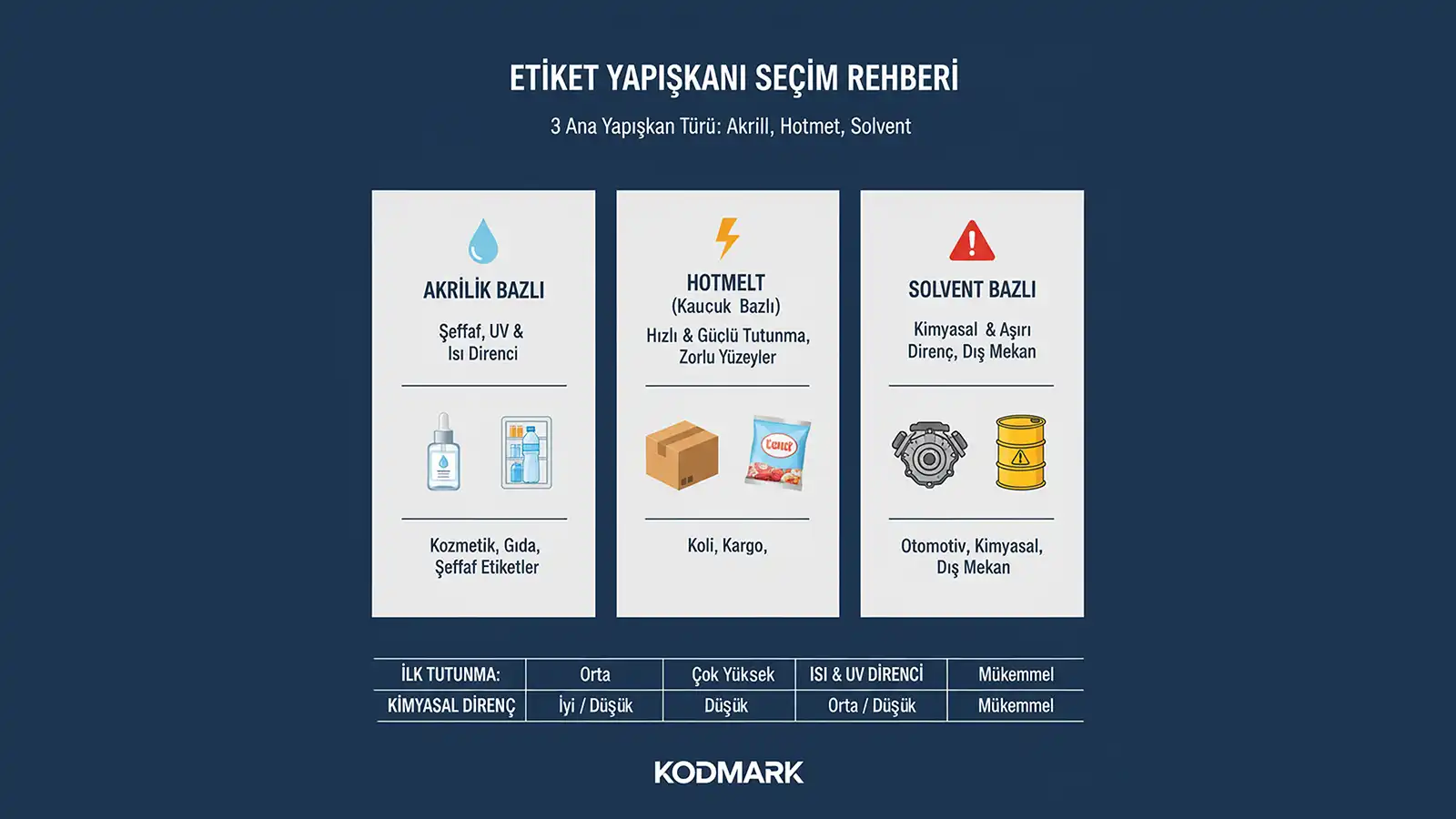
While the market offers many options, three main families dominate the label industry: Acrylic, Hotmelt (rubber-based), and Solvent-based adhesives.
1) Acrylic Adhesives — The Balanced Standard
Acrylic adhesives are versatile and widely used; available in water/emulsion-based formulations.
- Advantages: Non-yellowing excellent clarity (ideal for transparent film labels, no-label look); high UV and heat resistance; broad surface compatibility (glass, metal, PET); long lifespan.
- Disadvantages: Full adhesion takes 24–48 hours; initial tack is weaker than hotmelt.
- Applications: Cosmetics, food & beverage, household cleaning, healthcare, retail.
2) Hotmelt Adhesives — Fast and Strong
Made from synthetic rubber; applied hot and cures rapidly as it cools.
- Advantages: Very high initial tack; excellent on rough/porous surfaces (cartons, wood, textiles); better than acrylic on cold or slightly damp surfaces.
- Disadvantages: UV and heat resistance low to medium; may yellow or lose performance over time; not suitable for clear label applications.
- Applications: Shipping/carton labels, freezer products, tires, furniture, textiles.
3) Solvent-Based Adhesives — Expert for Harsh Conditions
Created by dissolving adhesive polymers in solvents; after evaporation, a high-performance film remains.
- Advantages: Best resistance to chemicals, heat, UV and water; excellent outdoor performance; strong adhesion even on LSE plastics (PP/PE).
- Disadvantages: Higher cost than other types.
- Applications: Automotive (engine parts), industrial machinery/drums, electronics, outdoor equipment, chemical containers.
Quick Comparison Table
| Feature | Acrylic | Hotmelt | Solvent |
|---|---|---|---|
| Initial Tack | Medium | Very High | High |
| Heat & UV Resistance | Good–Excellent | Low–Medium | Excellent |
| Chemical Resistance | Medium | Low | Excellent |
| Clarity | Excellent | Low | Good |
| Difficult Surfaces | Medium | Excellent | Excellent |
| Cost | Medium | Low–Medium | High |
Tip: For transparent labels with a no-label look, acrylic is best; for rough cartons or cold chain logistics, hotmelt is ideal; for chemicals and outdoor use, solvent-based adhesives perform best.
Conclusion: The Right Adhesive is Your Brand’s Guarantee
When choosing, consider not just the surface, but also storage, transport and usage conditions. If unsure, consult Kodmark’s experts for tailored recommendations.
Related reading: The Art of Choosing the Right Label · Anatomy of a Label · Paper vs. Film (PP/PE/PET)